

“No two fermions can occupy the identical quantum state .” This is the principle articulated by the Austrian physicist Wolfgang Pauli when he introduced his famous Exclusion Principle. Simply put, two objects cannot occupy the same space at the same time.
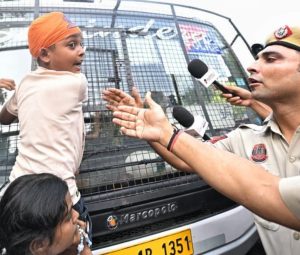
It is the ongoing protests in Delhi that bring this Exclusion Principle—a concept of profound significance in quantum physics—to mind. While these protests have infused new vitality into Indian democracy and stand as a testament to the political vigilance of the nation’s youth, they also expose some of the fundamental weaknesses inherent in that democracy.
The youth protests, initially sparked by concerns over examination irregularities, soon became an outpouring of deep-seated public anger against the anti-people policies pursued by the Narendra Modi government. The movement that began at Jantar Mantar in Delhi has since spread to cities across India. Yet it is equally clear that this agitation—centred on the charge of “Vote Chori”—has failed to generate any significant resonance in India’s rural regions or among its Adivasi communities. One of the principal reasons is the social exclusion these regions continue to face.
This exclusion is not something deliberately engineered by the protesters; it is a reflection of the social reality that confronts India. It manifests in two principal ways. The first is the digital divide that persists across the country. The youth-led movement began on social media. India watched the ‘Cockroach Janata Party’—launched by Abhijit Deepke across Instagram, X and YouTube—gain considerable traction among the nation’s youth, its calls to action moving from screens to the streets. Through videos, memes, infographics, and carousel posts, the campaign reached middle-class youth with ease.
The reality, however, is that India’s tribal and rural regions—subject to extreme digital exclusion—remain outside the reach of this effort. Even today, many areas lack mobile towers, broadband connections capable of downloading high-resolution videos and images, or even smartphones. Consequently, these communities are naturally shut out of promotional strategies and outreach methods designed for the Gen-Z generation. The digital divide experienced by tribal and rural India should not be regarded merely as a technical shortcoming; it must be understood as a form of exclusion embedded in the foundations of the nation’s development and economic policies.
Beyond the digital divide lies another critical question: to what extent did the issue that first ignited the student protests—the NEET question-paper leak—affect India’s tribal and rural regions? The question is vital, for exclusion from higher education is arguably more acute in these areas than anywhere else.
India’s rural and tribal belts have long been sites of persistent conflict and resistance. We often remain unaware of the numerous struggles unfolding across the country’s ‘tribal corridor’—encompassing Chhattisgarh, Jharkhand, Odisha, Bihar, West Bengal, and Madhya Pradesh—against the transfer of public resources to corporate interests. It is an equally stark reality that mainstream media and opposition political parties have largely ignored these protests, failing to bring them into the national spotlight. Here resides the principle of exclusion mentioned earlier, one that is woven into the very fabric of India’s democratic system. We have treated tribal and rural regions—often described as India’s “mineral corridor”—merely as sites of resource extraction on the path of development. In doing so, we have consistently disregarded any claims these communities might make to democratic rights or social progress, and have arrived at our present condition.
We cannot move forward by accepting this principle of exclusion as an immutable social reality. While it is claimed that India has embraced the movements led by its youth, we remain blind to another India—one that has been systematically cast out—together with the persistent struggles and conflicts in those regions as people fight for their fundamental rights. This narrowness of vision serves only to preserve the existing order, leaving it entirely unscathed.
It is impossible to transform a system deeply rooted in inequality and riddled with corruption without challenging the highly centralised, top-down policies that seek to transplant India’s tribal and rural regions into a different time and place in order to “bestow” upon them the benefits of socio-economic development.