

Preliminary Words
Aushadh Sar Sangraha (Compendium of Medicine) was published in 1819 (according to Bengali calendar it was 1226). The period was the very early formative days of British rule. This small book consists of 95 pages and 56 entries of different drugs and chemicals, primarily used in the British Pharmacopoeia. He not only mentioned in detail the use of European drugs, but also entered at length a good number of indigenous drugs of time-tested proven efficacy.
Truly speaking, this book by Sen connotes a layered history of his time. While reviewing the book we won’t write “His-story”, rather a nuanced and multi-layered history of Indian society and British modernity in its early shape as well. Missionary activities and medicine were the two strong humane faces of colonialism with the aid of which they could win the heart, conscience, loyalty and consciousness of subjugated Indian people. Ramkamal’s book is representative of this period in flux.
Beyond this it also lays bare to its reader an introspective critical analysis of the health condition of the late 18th and early 19th centuries. This book also bears testimony to Bengali language of its infancy – in its syntax, the use of punctuation marks and the use of words. Vidyasagar made mark on Bengali syntax, punctuation and the use of “effective” words after at least three decades after the publication of this book. In this sense, Aushadh Sar Sangraha is an interesting read for Bengali language. It is especially so when this book is placed against the perspectives of health conditions and mode of treatments prevalent during the period under consideration.
Following this, my review of this book is not confined only within the book. I have arduously tried to seize upon the time period which gave birth to this valuable book. Moreover, without understanding the scenario of treatments and medications of his time – both antedating and the following period – we cannot fully appreciate the intellectual value of the book.
A photo of Ramkamal’s book’s “Tile page” is given below. 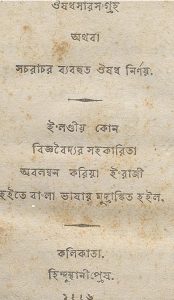 In his introduction of the book he told his readers – “In recent times as the English governance is flourishing, European medicine and doctors are increasingly amassing fortune, and Hindu Ayurvedic texts and their practices are getting dwindled and are facing paucity. As a result, many of people of high echelons are using English medicines. But no English medical text has so far been written in Bengali, which leads to inadequacy of knowing the theory of English medicine. As a consequence, the medicines which are so essential for everyday practice and use are not grasped by their names, quality (গুণ) and therapeutic property (অধিকার). Hence I publish this book with all these attributes in Bengali language for universal use, especially for common men. If this book is accepted and appreciated and becomes useful for people, then those medicines/drugs which have not been included in this book will again be published with these inclusions in the next edition. – Shri Ramkamal Sen.”[1]
He further wrote in his text (given in pictures below):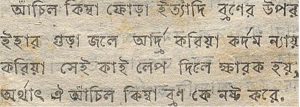
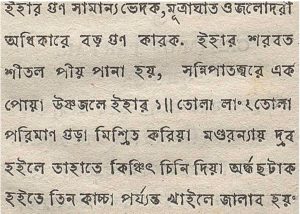 I do not translate these two parts of his text. But a few things must come to the notice of any attentive reader – (1) as Bengali language in its structure and syntax was in its infancy and did not have any standardized punctuation marks, Ramkamal, unlike English language or post-Vidyasagar Bengali language, used only semicolons and full stops in the sentences; (2) the use of “quality (গুণ) and therapeutic property (অধিকার)” signifies the impact of classical Ayurveda in his writing (in the Sutrasthana of the Caraka-Sanahita quality (গুণ)[2] has been dealt with as a derived concept of Samkhya philosophy, the same holds good for therapeutic property (অধিকার) too.
Regarding publication of this book by Ramkamal, historically it should be mentioned that in the next year i.e. 1820 Vidyaharabulee (বিদ্যাহারাবলি) was published. S K De informs us – “ Vidyaharabulee or Bengali Encyclopedia, Vol. 1. Anatomy, translated into Bengalee from the 5th edition of Encyclopedia Britanica by F. Carey. Assisted by Sreekanta Vidyalankar and Shree Kobichundra Turkasiromoni, Pundits. The whole revised by Rev. W. Carey D. D. Serampore. Printed at the Mission Press, 1820 (Nov. 1).”[3] That was the period of making common medical texts.
One researcher has commented – “To translate a book on medical science into Bengali from a foreign language was itself a difficult task. It more so especially in the days when Bengali prose was in its infancy. In the nineteenth century Bengal, eminent Bengali authors, before or after Ramkamal, mostly engaged themselves in translating or adopting creative literature of the other languages into Bengali[4] … But the writers of scientific books in Bengali had no tradition as such. Since Ramkamal was the author of a book, the subject which had never been dealt with in the Bengali language by any person before him, he had to follow a style peculiarly his own in writing useful prose to express his ideas. In that sense he was a path-finder and a pioneer.”[5]
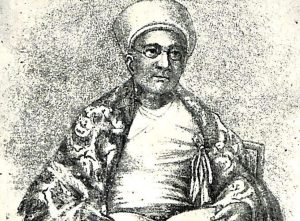
Ramkamal Sen and the Societal Picture of the Period
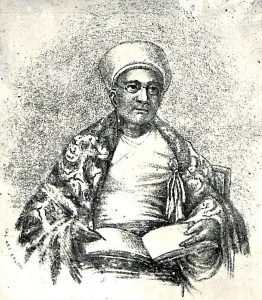
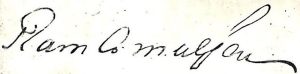
(Ramkamal Sen and his signature – Wikimedia Commons)
I have focussed on Ramkamal primarily up to the period 1819 – the year of composition of Aushadh Sar Sangraha. There are a number books and research articles on Ramkamal Sen. Most likely, amongst all of these works the biography of Ramkamal Sen (?1870) by Pyarichand Mtra is one of the best documents. The English version is now very difficult to trace. Later on, a Bengali translation of this was done by Sushil Kumar Gupta and it is now available.[6] In his “Introduction” to the book, Jogesh Chandra Bagal, editor, informs us – “A man of virtuous character Ramkamal Sen was a person possessed of geniuses and untiring workmanship. All the events and institutions organized and founded in the beginning of the nineteenth century, Ramkamal was intimately associated with all these efforts. His wholehearted efforts were devoted to these jobs … Even a few years ago Ramkamal Sen was almost unknown to Bengali readers or their knowledge of him was very superficial. Pyarichand’s book was in English. Hence its contents were almost unknown to Bengali people.” After this statement, Bagal has shown his discomfort with Shivnath Shastri’s book[7] as Shastri has not given due recognition to Ramkamal Sen and, also, to Raja Radhakanta Dev … Ramkamal Sen was orthodox, yet reformist.
Ramkamal came to Calcutta (now Kolkta) and resided at Kolutola and began to learn English from Ramjay Datta.[8] “On 19 December 1802, Ramkamal Sen, began his professional career under Mr. Nami (often transliterated as Mr. Namey) was the Chief Magistrate of Calcutta … In 1804, he began to work in Hindustani Press at Rs.8 per month. Then he engaged himself at Chandni Hospital in 1808. It seems possible that his work and experience in the Hospital might have roused his medical knowledge and his interest in medical writings. In 1812, he joined the Fort William College under Colonel Ramsay. From 1818 to 1819 he worked as a clerk in the Asiatic Society at Rs.12 per month.”[9]
As an aside, it should be mentioned that he was also a lexicographer and wrote a dictionary for English learning people/pupils.[10] Mitra has commented – “He had a sound knowledge of Sanskrit and ancient Bengali language.”[11] An example can be given in this regard. In the entry number 29 of his book he described “Ringworm Ointment”.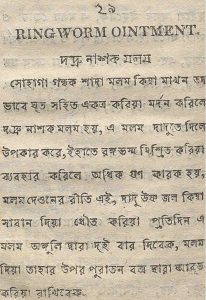 Those who can read and understand Bengali the passage reproduced above does not pose any problem. But those who cannot read it, for them it is useful to understand that “In the above passage at least twenty-six Sanskrit words could be found in addition to a very few Persian and Arabic words such as ‘malam’ (ointment), ‘saban’ (soap) etc. Nouns and adjectives had been mostly derived from Sanskrit and a few from Arabic and Persian. But the most interesting point was that Ramkamal preferred such words of foreign origin which were frequently used in Bengali language even in the early nineteenth century. The Bengali language had adopted them as its own and it had practically no other synonyms of such words.”[12]
Further, “One of the most significant aspects of his translation was that to communicate his ideas he preferred to choose words commonly used by the people remaining unconcerned about their origin. He suffered from no inhibitions. He picked up words from English, Arabic, Persian and Sanskrit languages which could convey his idea and at the same time would be intelligible to the readers without any difficulty … unnecessarily did not, for the sake purity of language of Gaur, choose to make his translation pedantic.”[13]
Another valuable research work states – “Englishmen and Indians, however, could not remain in two hermetically sealed mental worlds. Intercourse, commercial and administrative, brought the two peoples into closer relationship. The establishment of English rule in Bengal was destined to produce far-reaching social and cultural changes.”[14]
Moreover, “the first managing committee of the Calcutta School-Book Society for the year 1817-1818, included orthodox Hindus like Pandit Mrityunjay Vidyalankar, Radhakanta Deb, Ramkamal Sen and Tarinicharan Mitra. The Muslim members of the Committee were Maulavi Aminullah, the Company’s vakil at the Sadar Diwani Adalat, and distinguished Persian and Arabic scholars like Maulavi Karam Hussain, Maulavi Abdul Wahid and Maulavi Abdul Hamid.”[15] Such a figure represents before us a peaceful and harmonious coexistence of Hind-Muslim-Arabic-Persian culture. This was later broken.
It is historically a significant phenomenon that after the formation of the Calcutta School-Book Society and the publication of quite a good number of texts in various languages, the habit of reading began to increase among the newly educated people of Bengali society. As a result, a new social, cultural, economic and political equation began to emerge and bear lasting fruits. This equation can be presented thus –
The expansion of English and vernacular education > instead of traditional single copy manuscripts, production of huge number of printed books > emergence of an extended new readers’ class > ramification of English education through various channels and tributaries > production of techniques of “modernity” and the adaption of it by people at various sections of society > expansion of “print capitalism” and the newly emergent industrial capital. At such a juncture, there was the emergence and growth of personalities like Ramkamal Sen. We can take a stock how many books were printed the Calcutta School-Book Society in its first years. It will clarify our argument.
“A look at the early publications of the society gives us a clearer idea of various aspects about the production of the books:
Ganitanka. Harley’s Arithmatic. For the use of the Bengalee Schools, 1819. Rev. J. Harle. Chinsurah. School Press – number of prints unknown.
Bhugol Brittanata. Geography interspersed with information historical and miscellaneous. Rev. W. H. Pearce. Calcutta. Mission Press for the Calcutta School-Book Society. 1819. Print run 2000.
Pathshala bosaibar o balakder shikhaibar dharar bibartan. Instructions for modelling and conducting schools. Re. W. H. Pearce. 1819. Print run 500.
Niti katha. Pratham bhag. Fables in Bengali language for the use of Schools. First Part. Radhakanta Deb. 1819. Print run 5000.
Niti katha. Dwitiya bhag, or Fables in Bengali language for the use of Schools. Second Part. Radhakanta Deb. 1819. Print run 4000.
Manoranjanetihas, or Please Tales. Stories designed to improve the understanding and direct the conduct of young persons. Tarachund Dutt. Calcutta. Printed at the Mission Press for the Calcutta School-Book Society. 1819. Print runs – not available.”[16]
From the statistics given above it becomes evident that the year 1819 when Ramkamal’s book was published, in the same year the number of books printed amounted to 11,000 to 15,000 copies. And, more importantly, most of them were textbooks or books for the social production of new morality, principles, habits or ethics consistent with colonial modernity.
To remember, it was the period of transition from “village” Calcutta to “urban” Calcutta – though, unlike Europe, no societal churning or revolution occurred here. The concept of modernity was rather “engrafted”. A few pictures are given below to shed light on this transition period.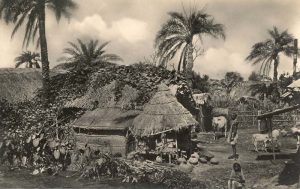
(A picture of “village” Calcutta)
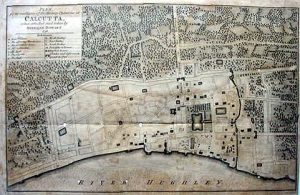 (Battle Plan for the Intelligence of the Military Operations at Calcutta When Attacked and Taken by Seerajah Dowlett Engraving dated C. 1760. Courtesy: Antique Maps Online – https://www.antique-maps-online.co.uk/calcutta-battle-plan.htm)
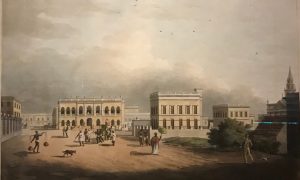
(The old Old Court House – “urban” Calcutta being built up)
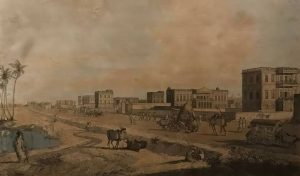
(Streets and ponds of “village” Calcutta at the end of the 18th century or the beginning of the 19th century. Artist: Thomas Daniell. All the pictures, except the map for battle plan, has been taken from his book Oriental scenery: one hundred and fifty views of the architecture, antiquities and landscape scenery of Hindoostan (1816).)
Let us delve a bit deeper into this transition period. “Christians, 13,138; Mahommedans, 48,152; Hindus, 118,203; Chinese, 414; making a total of 179,917 only. Besides the resident population, about 100,000 persons enter Calcutta city daily, from the suburbs and opposite side of the river.”[17] Simply put, the number of people entering Calcutta everyday for job or sundry works was 1,00,000 – more than half of the residents of Calcutta.
Let us see now how was the condition of health of people of Calcutta? “Every one knows that this city contains thousands of poor strangers, of all ranks, without wealth, connexion, or friends, who when afflicted with disease, fly from the city, and receiving medicine, and the prescribed regimen elsewhere, recover : but some die on the road, and many perish for want of two pice worth of medicine. Those who live from hand to mouth cannot obtain proper food or medicine, and for them there is no relief. Those who have no attendance, and no means of obtaining medicine, perish of course by hundreds in the city.”[18]
The inevitable question will arise: why so many words are written for Ramkamal’s book? The only plausible answer is without understanding this transition period of Calcutta, along with its health and topographical condition, we may fail to fully comprehend the pivotal importance of this book Aushadh Sar Sangraha (Compendium of Medicine).
The State of Medicine and Treatment at the End of 18th and the Beginning of 19th Centuries
According to Crawford, “The first hospital in Calcutta was opened towards the end of 1707 or early in 1708. Its construction was ordered in Fort William Public Cons, of 16th Oct., 1707.”[19] Primarily British soldiers and Seamen were treated in this hospital. No “Native” did not have any entry to this hospital. They could any treatment here.
By an order from the Fort William, it was stated that ““Haveing abundance of our Soldiers & Seamen yearly Sick, & this year more pticularly our Soldiers, & the Doctr representing to us, that for want of an Hospitall or Convenient Lodgeing for them is mostly the occasion of their Sickness, and such a place will be highly necessary as well for the Garrison and Sloops as Company’s Charter party Shiipping to keep the men in health, tis therefore agreed that a convenient spot of ground near the ffort be pitcht upon to build an Hospitall on,”[20] (Spelling and punctuation marks remain unchanged. Emphasis provided by me)
Captain Alexander Hamilton remarked in 1708 regarding the Hospital in Calcutta in a very humorous way – “The Company has a pretty good Hospital at Calcutta, where many go in to undergo the Penance of Physick, but few come out to give Account of its Operation.”[21] Put it otherwise, few people could come out in a good physical condition to report about the internal condition of the Hospital, which means mortality rate was very high.
Talking about British medicine in 1767, Rev. James Long informs us under the heading “Medicines, Price and Class” (in entry number 960) – “We flatter ourselves that this will not appear extraordinary when it is considered that nearly five thousand Europeans partake yearly of Hon’ble Company’s medicine, besides sepoys and other black people in their service”[22]. Another entry (number 494) under the heading “Medicine for Jagat Set (from Roroyan, September)” he states – “Your friendly letter in answer to mine, with the oil and extract of horn and other medicines wrapt in paper for he cure of Juggut Seat’s (one of the colluders for the ouster of Siraj-ud-Daula, and presumed by some historians the biggest banker of the world) arm dislocated by his foot slipping … I will forward them to Juggut Seat.”[23] It is interesting to note that medicines included (1) oil, and (2) extract of horn – both of which do not bar any medicinal value from present day perspective to arrive at the conclusion that British medicine too, like that of Bengali language, was in its infancy, NOT laudable at all.
In the next entry (495) under the heading “A Doctor wanted to apply medicine to Jagat Set” it was mentioned – “I (Jagat Set) have not used them, they remain as you sent them. I hope you will order to the people to write the direction and what regimen is necessary to be observed and shall immedialy comply with them … and therefore from your favour it is I have received so great benefit … as long as I have life I shall retain a grateful sense of it.”[24]
Most likely in 1806, Francis Buchanon-Hamilton wrote – “Medicine (Baidya-sastra) is taugh by several of the Pundits, some of whom also, although they are grammarians, practise the art. The books on medicine chiefly studied in these districts, are the Sarangadhar, Babhat and Chakradatta.”[25] What it signifies that with a smattering of knowledge anyone, even who were chiefly grammarians, would practice. The practice of medicine ofcourse was in a deplorable state.
Though British and Indian medical practice cut a sorry figure during the period, British surgery without any doubt excelled to such a degree that it gained Indian people’s confidence very soon.
An example may be provided. Richard O’Shaughnessy did an excellent surgery of some young man Uday Mandal of his very big jaw tumour. I took only 10 minutes to finish the whole surgery. And blood loss was minimal – 250 to 300 grams only.[26]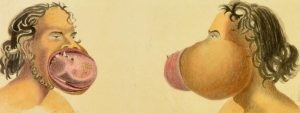
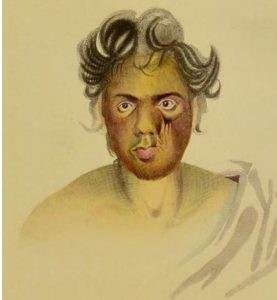
(The picture of the patient before and after the surgery – drawn by Richard O’Shaughnessy)
Against this perspective C. A. Bayly observes – “When the British denounced Indian backwardness in theory, they meant their continued adherence to Aristotelian humoral notions which had only recently been abandoned in Europe. The insecurity of European knowledge was a potent element in their rages.”[27]
Lt us have a look at the then hospitals to assess the condition and nature of treatment.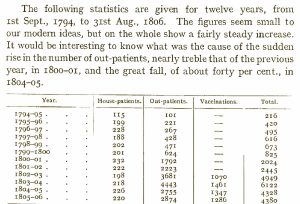
(Crawford, HIMS, vol. 2, p. 425)
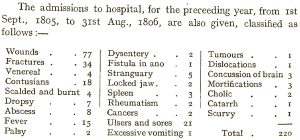
(Crawford, HIMS, vol. 2, p. 426)
Following these observations, we can deduce a few issues of importance:
- With the transition of the “village” Calcutta to “urban” Calcutta, the number of patients and various diseases treated are getting increased.
- Truly speaking, there was no institutional mode of treatment for Indian people.
- Meagre health support could provide little or nothing to 1,00,000 people who would come daily for sundry jobs to Calcutta.[28]
- Such a situation must have led to primary prevention of diseases at the basic level – residences of the people of Calcutta. More specifically, these treatments should be aimed beyond nostrums. It should be an empirically proven and time-tested mode of treatment.
- Ramkamal Sen’s book bears historical significance at this juncture. Without being a medical person, as an acutely sensitive social reformer he ventured into the field of medicine to help common people to find a scientific mode treatment for their diseases.
Before the publication of Ramkamal’s book Whitelaw Ainslie (“Superintending Surgeon” of the Madras Establishment) published his Materia Medica of Hindoostan in 1813.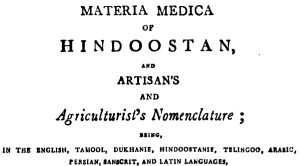
In his Introduction to this book, Ainslie informed his readers – “It has long been a source of regret that there was no where to be found a correct list of what particular articles of the British Materia Medica could be procured in the Bazars of Hindoostan … The names given by the Natives to some articles of diet, and other things necessary for the comfort of the sick…”[29] Two important issues should be noted by readers – (1) in the bazaars of India, many herbal medicines and mineral drugs could be easily found and procured, and, more importantly, (2) the aim of all these efforts were “comfort of the sick”.
At the end of the 18th century, a prominent Welsh naturalist Thomas Pennant wrote about Indian medicine (Bengal was no exception) – “In bilious cases, they prescribe copious purging; they shun bleeding and emetics. In feverish disorders they widely rely on extreme abstinence, and the sovereign medicine water-gruel made of rice … Surgery is totally unknown among Hindoos. It should be seen that in case of wounds, gun-shot or sabre, nothing more was done”[30]
Another vivid account of the medical practice at the beginning of the 19th century was provided by Soorjo Goodeve Chuckerbutty, one of the first four students of the Calcutta Medical College, who made first Indian medical sojourn to England for higher learning. In his own words – “The medical education of those days scarcely deserved the name; as a general rule the profession being then still claimed as a birth by certain castes … Every Boydo was a born Koberaj … those Koberajes going about the village … Drastics and tonics were the most in request … Fasting, as a general rule, was rigidly enforced during the first days of all acute diseases … The chief food of the patient commonly consisted of Batasha (sugar puffs) and water Khoe (rice fried in the paddy), conjee, conjee mixed with gravy of some vegetables or fish curry, and, lastly, rice and dall.”[31]
He has mentioned particularly of Kobirajes – Ramdullub Sein and Nillumber Sein – who “were widely known, and they were reported to have effected extraordinary cures.”[32] He has praised Nillumber Sein thus – “it was curious to see how the villagers flocked around to have s sight of him all along the road.”[33] Chuckerbutty has mentioned about a case of Nillumber, who was in his last stage of dysentery – “finding that he could do nothing in the way of cure, he boldly foretold the day and hour of death, which proved to be correct.”[34] We can assume that instead of diagnosis there was much emphasis on prognosis.
Next, Chuckerbutty has enumerated various types of practitioners who roamed from village to village and did their medical and surgical jobs. They may be enumerated thus – (1) “Barber-Surgeons”, (2) Ticcaders, (3) midwives, (4) itinerant eye-doctors, who went about to perform the operation of extraction for the cataract, (5) itinerant phlebotomists , who bled for all sorts of pains and aches, (6) itinerant lithotomists, who cut for stone in the bladder, (7) itinerant cuppers, (8) itinerant leechmen, (9) itinerant devotees, who sold all manner of charms and amulets for the prevention and cure of diseases, (10) itinerant exorcisers, who pretended to cure hysteria, mania, and epilepsy by expelling evil spirits, (11) Ojhas, who professed to extract the venom from poisoned wounds by charms, incantations, and religious mummeries, (12) priests of Hindu temples, who advised penance and money-gifts to particular idols, (13) acupuncture-men, who would puncture the enlarged spleen and liver, (14) issue-men, who would make large issues on the legs and arms for all diseases of plethora, (15) women-doctors for complaints connected with the generative functions, (16) travelling aurists, (17) tooth extractors; and so on. Chuckerbutty observed – “It does not appear that they ever attempted to tie a bleeding vessel or to use internal injections, though in cases obstinate constipation, they often, introduced into the lower bowel a Pawn-stalk or oiled brinjal to procure alvine evacuations.”[35]
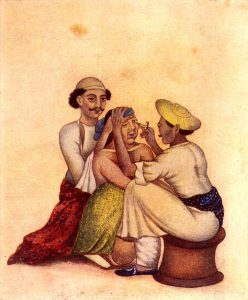
(Old couching for cataract removal)
There are some vivid descriptions during the transition phase from “village” Calcutta to “urban” Calcutta in Shivnath Shastri’s depictions. “Now a few words about the sanitary condition of Calcutta at the time. The inhabitants of modern Calcutta, with its hygiene and sanitary arrangements, can hardly conceive what a hot-bed of disease it then was. Bad drinking water, with the miasma generated in the filthy sewers, killed its residents in numbers. Besides such acute diseases as cholera and typhoid fever, diarrhoea did its slow but sure work of undermining the vigour of life and making it a burden. Many a robust youth from the Mufasal, on spending a few months here, lost his health, and had to return home to recruit it. The description of the unhealthy condition of Calcutta given by Kartikeya Chandra Rai, who came to the city some time after Ramtanu, and lodged with him, is as follows:
“Almost everyone coming to Calcutta for the first time was sure to have his digestive powers greatly injured. Diarrhoea was the first complaint, then followed fever. Recovery was doubtful, unless the sufferer hurried home, and placed himself under a regular course of treatment. I came here quite healthy, but within a short time my digestive powers were so injured that I was compelled to be very careful about my diet. I lived on very simple food; but yet, far from being better, I rather grew worse, lost all appetite, and my constitution became a wreck of what it had previously been. At length, my guardian took me home, and I commenced feeling better the day following my arrival there.”[36]
These vivid descriptions add more perspective against which Ramkamal’s book can again be read.
Aushadh Sar Sangraha (Compendium of Medicine)
The 7th entry of the book contains the title “SALT – লবন”. It deals with 4 types of salts – Glauber Salts, Rochille Salts, Epsom Salts, and Cheltenham Salts. Then he goes on to describe the qualities of different salts and different disorders. Regarding Cheltenham Salts he writes – “30 ratti of the salt (equivalent to about 5.5 grams) causes purgations, increases অগ্নি (fire) and clears constipation.”[37] This particular expression “increases অগ্নি (fire)” suggests the impact of Ayurveda on Sen’s explanation.
The entry number 8 contains the title “ANTIBILOUS PILL. এন্টিবিলিষ পীল – পিত্তঘ্ন বড়ি”[38]. In Bengali it signifies the drug which destroys pitta (fire). It also connotes the insinuation of Ayurvedic concept in the description.
9th entry has the title “CALOMEL কালমিল – পারা”[39]. About its usage and usefulness is stated thus – “On taking calomel the patient should be put on very light diet. It includes well-cooked food of sun-dried rice and milk and sugar. Heavy diets like meats and fish should be completely avoided. Head, body and feet should not be kept uncovered. Bathing should be avoided. The patient must avoid sleeping in a cold place and on the bed. He should always stay in a hot area.” We should pay attention to use of the phrase “well-cooked food of sun-dried rice”. It also signifies the influence of Ayurvedic practice on European medication. Again it also signifies a kind refraction and mutation from British Pharmacopoeia. Not only that, a kind of Indianization of European drugs s also taking place.
14th entry bears the title “PERUVIAN BARK বার্ক”.[40] To describe the drug Ramkamal writes – “Its colour is yellowish brown to some extent, slightly bitter and astringent with bad taste, in undulant fever this drug is panacea, in ague (fever with shivering and chill) and diurnal and intermittent fevers it gives very good result.”[41] (Readers should notice the punctuation marks – only semicolons and full stops).
“LAUDANUM লাডনম” is the 18th entry in the book.[42] Sen gives the description of this drug thus – “If opium and spirit of wine are mixed, then laudanum is produced … in severe pain 30 to 60 drops of laudanum is very effective if taken by mixing it with little water … laudanum is the principle medication for cholera … in the initial stage of olaotha (cholera) which means the hands and feet are not yet cold if 40 to 60 drops of laudanum mixed with brandy syrupa or hot water should be taken…”[43]
“SPIRIT OF HARTSHORN হার্টহারণ ইস্পিরিট” is the 19th entry. In its description it is told – “HARTHARAN (হার্টহরণ) spirit is produced by mixing alkali produced from burning horns of deer and chalk clay/kaolin and by distilling it … if one suddenly becomes unconscious or pulse is stopped the smell of this drug (SPIRIT OF HARTSHORN) instantly brings back consciousness and vigour is restored.”[44] It is intriguing to note here that I mentioned before that British medicine sent to Jagat Set contained “extract of horn extract of horn” (see note 23). The same thing again appears here.
Aushadh Sar Sangraha has got its entry number 29 under the title “RINGWORM OINTMENT দদ্রু নাশক মলম”. We have already discussed about it at the beginning of this paper.To me, the last important entry of Ramkamal’s book is the entry number 46 under the title “DECOCTION OF POMEGRANTE ROOT দাড়িম্ব শীকড়ের ছালের পাচন”[45].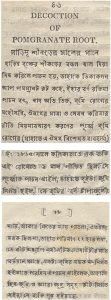 Sen writes – “This medicine is panacea for worm diseases, before the unique features what are seen should be written before deciding the quantity and mode of medication of this drug because if we do not know about these wonders no respect can be roused for this simple drug.”[46]
According to Ramkamal, even English doctors are baffled by its efficacy[47] – “In 1815, a man had been suffering from this disease for one month, when he took the above-mentioned decoction, two worms were emitted … the length of one of these worms was 22 arms in length (more than 45 feet), that worm is till kept in the room of the Asiatic Society…”[48] Further, in 1810, another worm of lesser length was emitted on taking this decoction – about 3 inches in breadth and 22 feet in length.[49]
I conclude my review of the book Aushadh Sar Sangraha (Compendium of Medicine) here. This review is a bit truncated in the sense that out of 56 entries in the book I have taken up less than half of these – though which have been discussed are all very important. This review reveals before us – (1) the deplorable state of Indian medicine and British analogue as well, (2) going against use of any nostrums Ramkamal Sen produced a manual of methodical, time-tested and efficacious drugs used at that time, (3) at the same it encompasses, though indirectly, the prevailing medical condition of the time – both British and indigenous, and (4) the infantile state of Bengali language.
All these taken together constitute the perpetual importance of this book even after 100 years.
___________________________________
[1] Ramkamal Sen, Aushadh Sar Sangraha, “Introduction”. Italics by the author. This book, along with other books of the same period, was mentioned in Rev. J. Long’s (ed.) A Descriptive Catalogue of Bengali Works, Containing a Classified list of Fourteen Hundred Bengali Books and Pamphlets Containing a Classified list of Fourteen Hundred Bengali Books and Pamphlets (1855). Long wrote – “The establishment in 1851 of a Bengali Class, in the Medical College, with 50 Government scholarships of 5 Rupees each per mensem, in which lectures are delivered in Bengali, on Anatomy, Materia Medica, the Practice of Medicine-will we hope soon lead to a considerable increase of Bengali Medical class works. Wise in his commentary on Hindu Medicine, shows the amount of knowledge of the Hindus on this point, and Royle proves that the Hindus knew medicine before the Greeks did. In 1818 appeared the Videá Nindá (বিদ্যা নিন্দা), a treatise ridiculing physicians, according to the old adage, “the destruction of 100 lives makes a physician, of 1,000 a doctor.” Ram Komul Sen anxious to spread medical knowledge in the Vernacular, published in 1819, (E. T.) Aushadh Sár Sangraha, pp. 95, in which he gave the names, origin, use and mode of application of 56 different medicines, such as jalap, rhubarb, castor oil, chiretta, calomel, mercury, &c. &c.,-in mentioning a decoction of the pomegranate root as useful for worms, he states the case of a man cured by it after 9 months’ illness and discharging a worm 30 feet long. In 1823, the Rogántak Sár, 3 Rs., was published by subscription ; the Editor promised the readers of it as an inducement to their taking the work, that they would acquire the power of healing diseases.”, pp. 33-34.
[2] M. Monier-Williams, A Sanskrit English Dictionary. This dictionary gives the definition of “guna” in its 5th entry like this – “an ingredient or constituent of Prakriti, chief quality of all existing beings (viz. sattva, rajas, & tamas, i.e. goodness, passion, and darkness, or virtue, foulness, and ignorance) – p. 357.
[3] Sushil Kumar De, History of Bengali Literature in the Nineteenth Century, 1800-1825 (Calcutta: Calcutta University Press, 1919), p. 251.
[4] As we have seen it the case of Vidyaharabali,. See n. 3 above.
[5] Pradyot Kumar Ray, Dewan Ramcomul Sen and His Times (Calcutta: Modern Book Agency, 1990), p. 177.
[6] প্যারীচাঁদ মিত্র, রামকমল সেন, অনুঃ সুশীলকুমার গুপ্ত, সম্পাদনাঃ যোগেশ্চন্দ্র বাগল (কলিকাতাঃ সম্বোধি পাব্লিকেশনস, ১৯৫৭)।
[7] Shivnath Shatri, Ramtanu Lahiri O Tatkalin Bangsamaj (Ramtanu Lahiri and the Contemporary Bengali Society) (Calcutta: S. K. Lahiri 7 Co., 1909).
[8] প্যারীচাঁদ মিত্র (Pyarichand Mitra), রামকমল সেন (Ramkamal Sen), p. 6.
[9] Ibid, pp. 7-8.
[10] Ram Comul Sen, Dictionary in English and Bengalee, from Todd’s Editionn of Johnson’s English Dictionary, in 2 volumes, vol. I (Serampore: Serampore Press, 1834).
[11] Mitra, ibid, p. 8.
[12] Prdyot Kumar Ray, Dewan Ramcomul Sen and His Times (Calcutta: Modern Book Agency, 1990), p. 178.
[13] Ibid, p. 178.
[14] A. F. Salahuddin Ahmed, Social Ideas and Social Change in Bengal, 1818-1835, 2nd edn. (Calcutta: Riddhi, 1976), p. 6.
[15] Ibid, p. 24.
[16] Abhijit Gupta, “The Calcutta School-Book Society and the Production of Knowledge”, English Studies in Africa June 20214, 57 (1): 55-65. Quotation on pp. 61-62.
[17] William Milburn, Oriental Commerce; or the East India Trader’s Complete Guide… (London: Kingsbury, Parbury, and Allen, 1825), p. 255.
[18] James Peggs, India’s Cries to British Humanity, Relative to Infanticide, British Connection with Idolatory, Ghaut Murders, Suttee, Slavery, and Colonization in India (London: Simpkin and Marshall, 1832), p. 203.
[19] D. G. Crawford, A History of Indian Medical Service, 1600-1913 (hereafter HIMS), in 2 volumes, vol.2 (London: W. Thacker & Co., 1914), p. 418.
[20] Ibid, p. 418
[21] Alexander Hamilton, A New Account of the East Indies, Being the Observations and Remarks of Capt. Alexander Hamilton, Vol. II (Edinburgh: 1727), p. 11.
[22] James Long, Selections from Unpublished Records of Government for the Year 1748 to 1767…, Vol. 1 (Calcutta: Office of the Superintendent Government Printing 1869), P. 514.
[23] Ibid, 234.
[24] Ibid, pp. 234-235.
[25] Francis Hamilton-Buchanan, An Account of the Districts of Bihar and Patna, Vol. I, p. 301.
[26] Richard O’Shaughnessy, “Case of Enormous Tumor of the Upper Jaw”, Quarterly Journal of the Calcutta Medical and Physical Society, January 1, 1838, pp. 1-7.
[27] C. A. Bayly, Empire and Information. Intelligence Gathering and Social Communication in India, 178-1870, 1999, পৃঃ ২৮১।
[28] Milburn, Oriental Commerce, p. 255 (mentioned before).
[29] Whitelaw Ainslie, Materia Medica of Hindoostan and Artisna’s and Agriculturist’s Nomenclature (Madras: Government Press, 1813), pp. i-ii.
[30] Thomas Pennant, The View of Hindoostan. Vol. II. Eastern Hindoostan (London, 1798, pp. 236-237.
[31] S. Goodeve Chuckerbutty, Popular Lectures on Subjects of Indian Interest (Calcutta, 1870), p. 138.
[32] Ibid, p. 139.
[33] Ibid.
[34] Ibid.
[35] Ibid, pp. 13-140.
[36] Shivnath Shastri, Ramtanu Lahiri, Brahman and Reformer: A History of the Renaissance in Bengal, From the Bengali of Sivanath Sastri (Ramtanu Lahiri O Tatkalin Banga-Samaj) (London: Swan Sonnenschein & Co., Ltd., 1907), pp. 49-50.
[37] Aushadh Sar Sangraha, pp. 11-14.
[38] Ibid, p. 14.
[39] Ibid, pp. 19-23.
[40] Ibid, pp. 27-30.
[41] Ibid, pp.27-29.
[42] Ibid, pp. 34-36.
[43] Ibid, pp. 34-35.
[44] Ibid, pp. 75-79.
[45] Ibid, pp. 75-79.
[46] Ibid, p. 76.
[47] Ibid, p. 77.
[48] Ibid, p. 78.
[49] Ibid, p. 78.