

It was almost 11 a.m. on September 7 when we reached the India–Nepal border. It was the first time I was crossing from India into another country. What surprised me was how casually the crossing happened. The Toto drivers were calling us to cross over to Nepal, as if we were simply going to a nearby town. I was astonished.
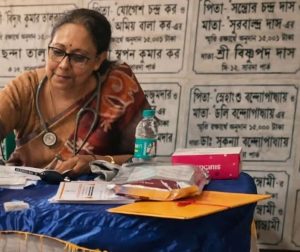
Our vehicle soon arrived. The eight-member team from Shramajibi Swasthya Udyog and Laliguras, travelling to Nepal for relief work, began our journey into the country.
It was a long road journey, and we were exhausted by the time we reached Kathmandu. After almost 20 hours of travel, with only brief periods of rest, we collected and organised the medicines we had brought and continued towards Nuwakot, one of the areas severely affected by the flash floods.
The organisation that hosted us was working with several other NGOs, with environmental rehabilitation as one of its major areas of work. The next day, we went for site visits.
What we saw was devastating.
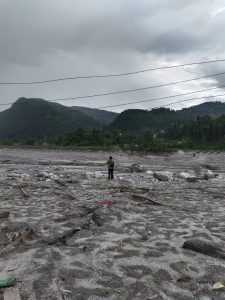
The village was almost completely buried under mud. We were literally walking at the level of rooftops. The destruction was far greater than what we had seen in videos or read about in the news. We could not help thinking that there might still be people trapped underneath the mud, many of whom may have already died.
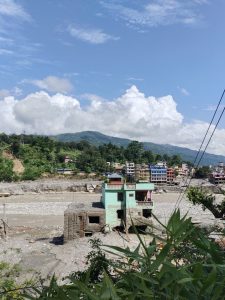
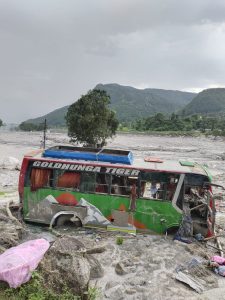
Over the following days, we interacted with people in the affected areas and visited a holding centre in the Bidur area. I am not going to describe everything we did or everything we encountered during those days. The scale of destruction itself left me numb.
I was not able to feel much—not sorrow, not anger. I simply moved through the affected areas mechanically, almost flatly, as though I was functioning on autopilot.
But that experience raised some very important questions for me—questions that need to be analysed critically.
What do we actually mean by rehabilitation?
What is the ecological crisis unfolding around us?
What role does the state play in creating and responding to ecological crises?
And what does internationalism mean in the context of such disasters?
I want to think through these questions from my experience of travelling through Nepal.
The ecological crisis
What is happening around us cannot be understood merely as isolated disasters or unfortunate events. These are symptoms of a much larger ecological crisis.
An ecological crisis can be understood as the potential destruction of the conditions that sustain human life on Earth. Those conditions are not limited to climate alone. They include what are often described as planetary boundaries: climate change, ocean acidification, stratospheric ozone depletion, disruption of the nitrogen and phosphorus cycles, freshwater use, changes in land use, biodiversity loss, and chemical pollution.
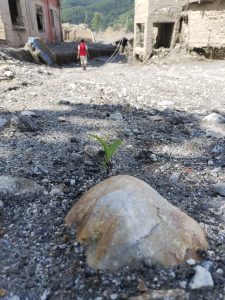
The disruption of any of these systems can produce enormous consequences, and we are already witnessing different manifestations of this crisis across the world.
To understand this crisis, one useful concept is the metabolic rift, developed within Marxist ecological thought and later elaborated by thinkers such as John Bellamy Foster.
From the very beginning of human evolution, human beings have interacted continuously with nature. Human beings are not separate from nature. We are part of it, and through our activities we constantly transform both ourselves and the natural world around us.
Therefore, nature itself cannot be understood as something static. Nature has a history, and the relationship between human beings and nature also has a history.
The mode of production within a society plays an important role in shaping this relationship. With the emergence and expansion of capitalism, this relationship has undergone a profound transformation.
Production has increasingly separated the places where resources are extracted from the places where they are consumed. Nutrients and resources are taken from the countryside and transferred to cities and industrial centres, while the waste is not returned to the natural system in the same way. The natural cycle is therefore disrupted.
This is what Marxist ecological thought describes through the idea of a metabolic rift—a disruption in the metabolic relationship between human society and nature.
From this perspective, what we see around us are not simply isolated disasters. They are symptoms of a much larger ecological crisis, and this ecological crisis cannot be fully understood without examining the existing mode of production and the economic system that shapes our relationship with nature.
Relief and rehabilitation
Then comes the question: how do we respond to these crises?
The immediate symptoms have to be addressed, and they have to be addressed in a humanitarian and environmentally responsible way. People who have lost their homes, livelihoods and means of survival need immediate relief. The bare minimum is the rehabilitation of people and their livelihoods.
Relief and rehabilitation are therefore essential.
But at the same time, we have to ask the harder question: what are the underlying causes that repeatedly produce these crises?
Addressing the immediate symptoms cannot be separated from organising and struggling against the structural conditions that produce them.
This creates a tension between immediate humanitarian intervention and the longer-term political struggle against the roots of ecological destruction.
The role of the state
Our interactions in Nepal also made me think about the role of the state during such a crisis.
From what we heard from local people, there was considerable dissatisfaction with the present government. Many people described it as a government that had replaced what they considered a bad government with something even worse.
The government was carrying out rehabilitation measures, and holding centres had been established. But there appeared to be very limited publicly available data about the affected population and about where displaced people were being accommodated. More importantly, these facilities seemed to cover only a very small proportion of the people affected by the disaster.
Even in the areas we visited, people who had lost their homes, property and livelihoods told us that the local administration had not visited them.
They were questioning the government’s response.
And these were not even particularly remote areas.
This raises another difficult question: if this is the situation in areas that are relatively accessible, what might be happening in the more remote, isolated and neglected parts of Nepal?
At the same time, the government’s approach appeared contradictory in several ways. There were concerns about how the scale of destruction was being documented and communicated, while much of the response was being channelled through NGOs.
We also encountered questions around the government’s position on foreign medical assistance. We were told that foreign medical practitioners were not being permitted to provide medical assistance in the affected areas, including organisations such as Doctors Without Borders, while Israeli doctors were reportedly being allowed to provide assistance.
These contradictions raise an important question: what is the state’s understanding of relief and rehabilitation during an ecological crisis?
People-to-people solidarity
For me, the simplest understanding of relief and rehabilitation is people-to-people solidarity.
Before travelling to Nepal, the India–Nepal border felt like a significant international boundary. Nepal was another country.
But when I crossed the border, that distinction became much less tangible.
The people living around the border have their own relationships, histories and everyday connections. People in North Bengal, for example, have social and cultural connections across the border. Their everyday lives do not necessarily stop at the line drawn on a map.
So I began to wonder:
How do these international boundaries actually relate to the lives of ordinary people?
A border can divide territories politically, but it cannot completely separate people’s histories, relationships, cultures and everyday lives.
Standing at the border, travelling through Nepal, meeting people affected by the floods and working alongside people from different organisations made the idea of internationalism feel much more concrete to me.
Perhaps internationalism, in such situations, is not merely about treaties, institutions or policies between states.
Perhaps it can also begin with something much simpler:
people standing with people.
When an ecological crisis crosses political boundaries, our solidarity also needs to cross those boundaries.
The floods in Nepal are not simply a “Nepal problem.” Ecological destruction does not recognise national borders. The same systems of production, extraction, consumption and environmental degradation connect us across countries.
Therefore, relief may begin with helping people survive the immediate crisis. Rehabilitation may mean rebuilding homes and livelihoods. But addressing the ecological crisis requires us to look much deeper—to understand the relationship between nature, society, the state and the economic system that shapes them.
My week in Nepal left me with more questions than answers.
And perhaps that is what the journey has given me most importantly: not just an experience of disaster and relief, but a reason to think more critically about ecology, rehabilitation, the state, capitalism and internationalism—and about how we, as people, choose to stand with one another.