

Date: 22.02.2025
Location: Kolkata
Ahead of the doctors’ invitation-based gathering with the Honorable Chief Minister of the state on February 24, 2025, the Joint Platform of Doctors, West Bengal, and Abhaya Mancha present some urgent concerns with the sincere hope of receiving logical and strong administrative responses.
To,
The Honorable Chief Minister & Health Minister,
Government of West Bengal.
Respected Madam,
On February 24, at the Dhanadhanya Auditorium, a gathering of government doctors of the state has been organized in your presence, along with the presence of government administrators. On behalf of the Joint Platform of Doctors, West Bengal, and Abhaya Mancha, we present some urgent concerns before you, with the sincere hope of thoughtful consideration and appropriate administrative action.
Looking Back:
• You are certainly aware that after the brutal murder of Abhaya at R.G. Kar Medical College on August 9, 2024, multiple critical flaws in the state’s public healthcare system have been exposed. Many of these issues had been brought to the attention of the health administration multiple times, and we strongly believe that they were preventable at an early stage. However, for unknown reasons, appropriate administrative steps were not taken in time, leading to a deeply entrenched undemocratic environment.
• We still believe that if transparent and rational administrative decisions are made without delay, it is certainly possible to restore the lost dignity of the healthcare system through permanent, scientific reforms and restructuring. Not only have shocking levels of massive corruption, the absolute absence of campus democracy, extreme anarchy at workplaces, and a dangerous culture of threats been exposed within medical colleges and various healthcare institutions, but institutions such as the West Bengal Medical Council, the State Health University, and the Health Recruitment Board have also, in recent times, dismantled every barrier of financial integrity, transparency, and ethical governance. These institutions have established an oppressive autocratic dominance by crushing the democratic space.
• We firmly believe that the immediate restoration of these esteemed institutions, along with structural reforms and urgent changes in governance, is crucial. Any superficial correction beyond this would be akin to applying lipstick to a case of oral cancer.
Key Urgent Issues for Maintaining the Quality of Public Healthcare (Ignoring These Would Be a Crime):
Permanent Workforce:
According to RTI data, about 40% of doctor positions and nearly 70% of paramedical and support staff positions remain vacant—and that too, based on the 1991 Establishment Table. Given this severe shortage, it is practically impossible to maintain service quality and meet the growing healthcare demands of the expanding public health sector.
• As per IPHS standards, the vacancy numbers are even more concerning. The situation is even more critical in medical education institutions as per NMC standards. Simply extending doctors’ working hours, entangling them in the “practice/non-practice” debate, or issuing unrealistic administrative directives inspired by idealized healthcare models—without addressing the fundamental staffing shortage—is an utterly unscientific bureaucratic approach, devoid of any practical implementation.
• The nature of medical service cannot be equated with that of an air-conditioned office job of a bureaucrat. Therefore, it is imperative to analyze the root causes of the crisis and implement permanent solutions.
• Recruitment in the healthcare sector has been stalled for a long time. The OBC reservation case is being misrepresented with half-truths, creating confusion. There is a growing perception that the case is being used as an excuse to deliberately delay recruitment. In reality, if there was genuine intent, necessary recruitments could have been conducted even within the legal framework.
• This prolonged staffing crisis has put an extreme burden on existing healthcare workers, leading to burnout and dissatisfaction. Overburdened doctors and healthcare staff are forced to work under intense pressure, which inevitably affects the quality of patient care.
Lack of Proper Infrastructure and Facilities
• The infrastructure in government hospitals and medical colleges is collapsing under the weight of increasing patient loads. While some new hospitals have been established, there has been no proportional increase in medical and paramedical staff, leading to an acute crisis in service delivery.
• Essential medical equipment often remains non-functional due to lack of maintenance, spare parts, or trained technical personnel. As a result, doctors are often forced to refer patients to private facilities, which goes against the principle of universal healthcare access.
• In several hospitals, basic amenities like clean drinking water, functional toilets, and adequate patient beds are lacking, causing significant distress to both patients and healthcare providers.
Medical Education and Training Crisis
• Government medical colleges in the state are facing a serious crisis in faculty recruitment. With many faculty positions remaining vacant, the quality of medical education is deteriorating.
• The introduction of contractual appointments instead of permanent faculty recruitment has further worsened the situation, as it discourages skilled professionals from joining government institutions.
• Medical students and junior doctors are often subjected to extreme workload and unsafe working conditions. The absence of structured work-hour policies and psychological support systems is leading to mental health issues, stress-related disorders, and even suicides among young doctors.
Administrative Failures and Corruption
• The West Bengal Medical Council, State Health University, and Health Recruitment Board have been completely compromised by corruption. Merit-based recruitment and promotions have been replaced by favoritism, nepotism, and bribery.
• Key administrative decisions are being influenced by political interference, sidelining expert opinions. This has resulted in a healthcare system that prioritizes political loyalty over efficiency and competence.
• The financial management of the health sector is riddled with irregularities, with funds meant for public healthcare often being diverted for unknown purposes. This has left hospitals struggling to procure basic medicines and essential supplies.
Campus Democracy and Safety of Doctors
• The brutal murder of Abhaya at R.G. Kar Medical College highlighted the complete failure of the administration in ensuring the safety of medical professionals. Despite repeated warnings about the deteriorating environment, no preventive measures were taken.
• There has been a systematic attack on campus democracy, with students and faculty being denied the right to raise legitimate concerns. Those who speak up against corruption and mismanagement face severe threats, harassment, and even physical violence.
• Junior doctors and interns face frequent assaults by patients’ relatives due to the failure of hospital security systems. The administration’s failure to provide adequate police protection and grievance redressal mechanisms has further worsened this issue.
Our Demands for Immediate Action
1. Urgent recruitment of doctors, nurses, and paramedical staff to fill vacant positions in government hospitals and medical colleges.
2. Permanent faculty appointments in medical colleges to improve the standard of medical education.
3. Infrastructure upgrades in government hospitals, ensuring availability of essential medical equipment and proper maintenance.
4. Strict action against corruption in the West Bengal Medical Council, Health Recruitment Board, and other health institutions.
5. Improved security measures for doctors and healthcare workers, including legal protection against violence.
6. An end to political interference in healthcare administration, ensuring transparent and merit-based decision-making.
7. Immediate action plan for mental health support for overburdened medical professionals.
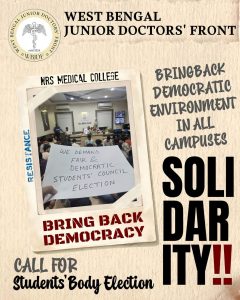
8. Restoration of democratic rights on medical campuses, allowing doctors and students to voice concerns without fear of persecution.
Final Words
The public healthcare system in West Bengal is at a breaking point. The failure to take immediate corrective action will not only lead to total system collapse but also put millions of lives at risk. As the Chief Minister and Health Minister, the responsibility to restore integrity, efficiency, and trust in the healthcare system ultimately lies with you.
We urge you to consider these concerns and demands with the seriousness they deserve and take decisive action to reform the healthcare system before it is too late.
With sincere expectations of positive change,
Joint Platform of Doctors, West Bengal & Abhaya Mancha





বাংলায় নেই কেন?