

Micro-Institutions in Practice: A Workers’ Health Model
In the earlier parts, I tried to touch upon the dilemmas faced by young professionals and the broader historical context in which NGOs have emerged. From here, I want to move toward something else—an attempt to think about alternatives. This is where the idea of “micro-institutions” comes in.
Before that, it is important to briefly reflect on a few points. If we look at NGOs historically, many critics argue that their role has often been to weaken left movements, mass mobilizations, and collective struggles. Their functioning largely depends on external funding—and with funding often comes forms of control. The ideas of “community” and “solidarity” within NGO spaces also tend to remain vague, while the focus shifts more toward projects than movements.
There are also structural limits to what NGOs can do. Even when individuals are committed, institutions often operate within boundaries. At the same time, NGOs sometimes create pathways—directly or indirectly—for neoliberal and imperial forces to enter marginalized regions. While they often present themselves as neutral and democratic, the reality is often more complicated.
Keeping these contradictions in mind, I started exploring the idea of micro-institutions—spaces that try to work differently.
One such example is Shramajibi Swasthya Udyog, a workers’ health initiative in the Howrah district of West Bengal.
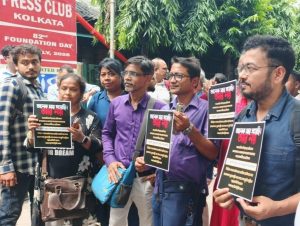
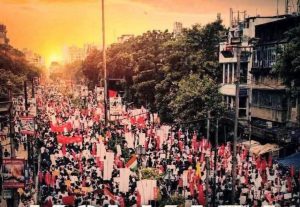
My first interaction with this collective—especially with Dr.Punyabarta Gun (Punnada)—was almost accidental. During my fellowship, when I was in Kolkata, at a time when protests were spreading across the city after the RG Kar doctor rape-murder incident, I came across them at different protest sites. Those initial interactions slowly turned into something deeper. Today, I am working with them and also writing on their platform.
To understand what makes this initiative different, we need to look at its history.
In the 1990s, much of West Bengal’s industrial landscape was centered around mills—jute, cotton, and others—spread along riverbanks. Workers in these industries often worked under extremely harsh conditions, with low wages and little job security. The Kanoria Jute Mill was one such place.
At that time, many existing trade unions had already begun to compromise with management. This led to growing dissatisfaction among workers. Around 3,000 workers came together, rejected traditional trade unions, and organized independently under the banner of the Sangrami Shramik Union. They didn’t just protest—they took control. They occupied the mill, formed a cooperative, and started running production themselves. As one worker described it, it felt like witnessing a kind of Paris Commune in our own time.
Out of this broader movement, new ideas began to take shape—including around health.
Influenced by the work of Shankar Guha Niyogi and experiences like the Shaheed Hospital in Chhattisgarh, workers began to think about building their own health system. Punnada, who had spent several years working in that context, played a key role in initiating this effort.
In 1995, the health project—Shramik Krishak Maitri Swasthya Kendra—was started. It began in a very modest way, in an abandoned poultry shed, funded by small contributions from workers themselves.
From the beginning, they were clear about one thing: external funding means external control. So they chose not to depend on CSR funds, government schemes, or external agencies. This made the early years difficult. But over time, the model became self-sustaining.
Their core idea is simple but powerful: rational, good-quality healthcare can and should be made available at very low cost. At the same time, they actively challenge two dominant narratives of the state—that proper treatment must always be expensive, and that people cannot demand better from the state. They stood against the irrational medical practice.
Unlike NGOs, they don’t run various fancy health projects . They simply run clinics—and do it well. Over time, their work has spread horizontally across different parts of West Bengal, often linked with ongoing people’s movements – recent one is the health clinic in Darjeeling for hill plantation workers and relief camps during natural calamities.
They believe that knowledge about health—and politics of health is important for building working-class consciousness. Through health worker training, they have engaged activists from different movements across West Bengal and nearby states like Jharkhand and Bihar to spread the awareness of health and it’s politics.
Interestingly, they are also able to bring in general and specialist doctors without depending on advertisements or high salaried fellowship programs. Their connection with student groups in Kolkata medical colleges like the Medical College Democratic Students Association helps create a steady flow of young doctors who are willing to engage with this kind of work.
But what stands out the most is that they do not see health movement in isolation, that has to be connected with movements for food, livelihood, housing, education, and dignity etc. Because of this, they actively participate in broader social and political struggles—whether it is movements like Nandigram and Singur, or more recent protests around state violence, women’s safety, and authoritarian tendencies- like Abhaya movement.
In my view, what they are doing is important not because it is extraordinary, but because it shows that something like this is actually possible.
Running a health system and being part of people’s movements are not separate things. They can go together.
What is needed is not just technical knowledge, but also commitment—trust in people, belief in collective struggle, and a continuous effort to build and sustain working-class consciousness.



I wish there was more detail in this article.
How many people do the clinics serve? How many doctors are there? What’s the operational cost and how much fees does it take for, say, a Caesarean, a diabetic foot dressing. What about pharmacy, what if someone has insulin dependence, how much does it cost?
Who are the “they” who participate in protests? If they’re the doctors what happens to the clinics when they’re at protest?
Which part of this is the “revolutionary” part? Running clinics? Political education? Attending protests? Doing all three?
If political education is revolutionary, what is the mode of operation here? Who does the education project? (You mention health activists) How are they funded? What is their pedagogy? How do they mobilize?
If attending protests is revolutionary, who organizes these protests?
Looking forward to a next part where I’m sure many of these will be answered.