


Sankar Guha Niyogi is more than a name- “A symbol of organised resistance by nameless numberless non persons claiming title to personhood and all the status and rights which belong to humans in the Indian republic with its adjectives of socialist democratic and sovereign” (Justice Krishna Iyer, first Guha Niyogi memorial lecture). His name is most talked over in the politics of India during the 1980s and the 90s.
Sankar Guha Niyogi : A Poltics in Red and Green by Radhika Krishnan delves into the rich ideas and experiences of a movement in Chhattisgarh which opened up the possibility of a radically different engagement of labour with questions of ecology and technology. Chattishgarh Mukti Morcha (CMM) established itself as a uniquely diverse organisation representing mine-workers, factory workers and agricultural workers across Chhattisgarh. In different chapters the author discussed in detail ‘Green and Red Imaginations’-Niyogi’s idea of ecology and development, labour and technogical choices in Chattishgrh, ‘Chhatishgarh for Whom’-a search for identity and a 24X7 union.
Rohan D’Souza said “Shankar GuhaNiyogi announces a fresh and exciting turn in the scholarship on environmentalism and development in postcolonial India”. The industrial worker has hitherto been portrayed in environmental and technological discourses as a passive recipient of technology. This book describes how the remarkable experiments carried out by Shankar Guha Niyogi sowed a new dream of an alternative people-oriented development model for Chhattisgarh.
In the 1970 and the 1980, the discourses around development was contested in multiple ways. The ecological contradictions were inherent in the Nehruvian approach of development.The CMM’s endeavours represent a recognition of the tensions within the Nehruvian model of development and the associated industrial project unleashed only after independence in India. It seeks to explore new dimensions of labour’s engagement with questions of ecology and technology.
The 1970’s saw the emergence of several groups highlighting the anxiety that science was not meeting the needs of our people the People’s Science Movement which saw the participation of scientists, activists and educationists is across the country was one of them seeking to hold the scientific community accountable for the trajectory of Science and technology in India. In this context, Neogi’s idea of sustainable development maintaining ecological balance became important.
In Chhattisgarh the Bhilai Steel Plant was established as one of the bulworks against backwardness to promote employment to transform the landscape and to place India on the map of industrial self Reliance. Shankar Guha Niyogi’s CMM emerged as one of the important voices interrogating this discourse of development and backwardness. In Chhattisgarh the CMM emerged as the voice of the workers, the peasants and the adivasis struggling to cope with new challenges. Hence, in CMM’s campaigns we find echoes of these varied voices of contestation- an anti-dam sentiment, the desire to defend forests against monoculture, anger against retrenchment caused by mechanization, a sense of alienation from land and rivers.
In interrogating the discourse of ‘environmentalism of the poor’ Amrita Bhabhiskar argues that Indian environmentalism tends to be dominated by Gandhian imaginations, middle class environmentalism and Hindu nationalism. Niyogi represents a break from ecologists, who steer clear of addressing class contradictions while addressing environmental concerns.
In India Mohandas Karamchand Gandhi was of course one of the most ardent voices against the received notion of scientific and technological progress and civilization. Gandhi’s hind Swaraj was a scathing critique of the belief that progress could be measured by sophisticated machines, technologies, weapons and standards of material comfort. He saw this so called indicators of progress as necessary evils. David Hardyman finds it hardly adequate to see Gandhi nearly as a backward looking representative of a traditional culture that was being destroyed inexorably by the forces of modernity. Ashish Nandy makes a case for Gandhi’s continuing relevance by reference to his vision of a society. This relevance is perhaps attested to by the fact that in the mine pits of Dalli Rajhara a trade union was to frequently invoke Gandhi in its polemics against mechanisation and the forced creation of obsolete human labour. Unlike Gandhi CMM was no advocate of a semi feudal rural economy, identified as a fetter to development. It recognised and invoked the role of labour in rural as well as industrial development as has been established at a time when mass production by the machine was leading to unemployment and berukhi (indifference) towards the work place. The virtues of production by the masses and the traditional technology, knowledge and skills found growing acknowledgement in the CMM’s vision. Niyogi perceives labour as a collective that strives to own, control and create structures technologies and products, and moreover a collective that will unitedly assert its right and aspirations. This vision of labour as a creative collective force is clearly in contrast to the Gandhian idea of labour as a moral individual duty. The undeniable celebration of human labour by Niyogi is in fact celebration of the creative collective possibilities and potentials of labour to innovate, create and finally transform the existing structure. Niyogi might have involved Gandhi to bolster his arguments, these fundamental differences in their approaches cannot be ignored. The opposition against mechanisation promoting semi-mechanisation is a struggle against alienation and obsolescence of human labour in Dalli Rajhara, which has been vividly described by Dr Punyabrata Gun in ‘Shankar Guha Niyogir sange kayak bachhar : ek sahajoddhar pratibedan’.
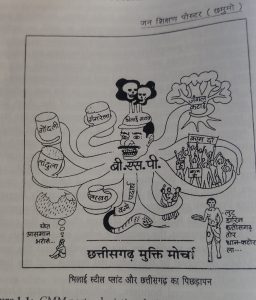
The relationship between ethnic and political identity is a contentious one. Jharkhand movement which begin as an assertion of tribal identity evolved over time as an ethno regional demand. Similarly in the formation of Uttarakhand the assertion of the Pahari identity was unmistakable. Chhattisgarh on the other hand presents a more complex stories. It was necessary to differentiate the Chhattisgarhi identity from such ‘son of the soil’ formulations. Progressive forces contended the CMM should never make this distinction between inside and outside forces. In fact the CMM countered the notion of dhartiputra, ‘son of the soil’ with its vision of shramputra (son of labour)- it was only by combining labour with soil that real progress was made possible, by internalizing the culture of the soil that the labourer became a real son of the soil this is how the CMM went on to define a Chhattisgarhi –
- A Chhattisgarhi is one who makes an honest living through his or her labour in the geographical area of Chhattisgarh
- A Chhattisgarhi is one who is committed to Chhattisgarh’s mukti
- A Chhattisgarhi is one who does not engage in feudal oppression
- A Chhattisgarhi is one who wants the people’s development in Chhattisgarh
- A Chhattisgarhi is one who believes in and practices international solidarity of the working class
- A Chhattisgarhi is one who has traditionally been a resident of Chhattisgarh but has subsequently left the region to earn a living and who does not exploit anyone
- A Chhattisgarhi is a person from any other nationality who is earning and honest living in Chhattisgarh industrial area through his/her hard work, who wants to permanently live in Chhattisgarh and who works with commitment towards economic social and cultural development
We get an idea of the CMM’s complete vision of a new Chhattisgarh which it posed as an alternative of sorts to the demand for a separate state, from a charter that framed the struggle for Chhattisgarh.
To establish an environmental policy that would ensure development rather than distraction to encourage patriotic production of a quality that would be compatitive in the international market to encourage chhattisgarh’s cultural identity to ensure primary education in Chhattisgarhi gondi haldi and other dialects.
The CMM rejects the discourse of Adivasi exceptionalism. Portraying the adivasi as a nature loving forest dwelling person who is a bulwark against the inexorable march of modernity won’t go with the idea of a trade union organising workers employed in one of the best known symbols of modernity in India. The distinction that the CMM drew between shram Putra and dhartiputra must be was a rejection of ethnic exceptionalism and a challenge to the idea of an exclusivist primordal identity based on either birth or regional domicile. In other words the CMM’s efforts attempted to convey the idea that ethnic regional and subnational aspiration even as they are expressions of material reality and lived experiences need to be constantly interrogative rather than unquestionably accepted.
“Apart from the immediate needs of the working class struggle, Comrade Niyogi had a vision of a future socialist society. He also had ability to translate this vision into the daily struggle of the working classes” (T.Vijayendra)
Radhika Krishnan’s book will enlighten the new generation about the lost possibilities that Sankar Guha Niyogi left behind.
Acknowledgement:
1. Dr Punyabrata Gun
2. Prof Kanchan Sarkar





A very analytical discussion of Radhika Krishnan’s book: Sankar Guha Niyogi : A Politics in Red and Green. Thank you so much, Gopa.